

- On June 4, 2026
- In blog
FR-4 PCB Material Properties: Electrical Specs, Thermal Conductivity, and Density
FR-4 stands as the undisputed workhorse of the electronics industry. For decades, it has remained the go-to choice because it balances cost, structural rigidity, and reliable insulation. To get the most out of your next design, let’s look at this classic material through three lenses: electrical performance, thermal conductivity, and density.
What Exactly is FR-4 PCB?
FR-4 is not a specific material name; it is a grade and an industry standard for glass-fiber-reinforced epoxy resin laminates.
Decoding the Name
FR (Flame Retardant): This indicates the material meets strict safety benchmarks, specifically the UL94V-0 standard. If a board catches fire, it self-extinguishes instantly. It refuses to burn.
The Number 4: This distinguishes it from other members of the family, such as FR-1 or FR-2. The “4” signifies its specific chemical formula and physical performance.
The Role in Circuitry
Think of FR-4 as the “divider.” In a PCB, it provides the essential insulation that keeps conductive layers apart and prevents shorts. How it fits depends on the board complexity:
Single or Double-Sided Boards: These are simple. A single core of FR-4 sits between two layers of copper, providing both mechanical support and electrical isolation.
Multilayer PCBs: This structure resembles a cake. Beyond the center core and the outer copper, thin sheets of Prepreg get stacked between the layers. After baking under intense heat and pressure, these layers fuse into a solid, unified PCB.
The Electrical Performance of FR-4 PCB
When evaluating how FR-4 handles electricity, two metrics take center stage: dielectric strength and dielectric constant.
Dielectric Strength
Think of dielectric strength as the “voltage ceiling.” It represents the maximum electrical field that FR-4 can block before it fails. If the voltage pushes past this limit, the material suffers a “dielectric breakdown.” At this point, the insulation effectively vanishes, letting current punch right through the board. The result? Total circuit failure and, in worst-case scenarios, a fire.
FR-4 typically holds a dielectric strength of roughly 20 kV/mm. When a team plans a layout, they use this value to calculate minimum trace spacing—often referred to as creepage distance. Keeping your physical spacing well beyond this critical threshold is the absolute baseline for a safe, reliable board design.
Dielectric Constant (Dk)
The dielectric constant measures how much electrical energy a material stores within an electric field. Why does this matter? Because it directly dictates signal propagation speed across the board. In a low-frequency setup, FR-4 maintains a Dk value between 4.2 and 4.8. However, this value shifts as the operating frequency climbs.
Here is the basic rule: a higher Dk value means a slower signal. When you build a high-speed circuit, you must know your exact Dk. A mismatched value will throw off signal timing and increase insertion loss. If you want to find a high-performance alternative, comparing the Dk curve of your substrate against other specialty materials is the first step.
| Material | Dielectric Constant | Loss at High Frequency | Cost |
| Fr-4 | 4.2 – 4.8 | Medium | Low |
| Rogers | 3.0 – 3.5 | Low | High |
| Polyimide | 3.5 – 4.0 | Low | Medium |
| Teflon | 2.1 | Very Low | High |
The Thermal Conductivity of FR-4 PCB
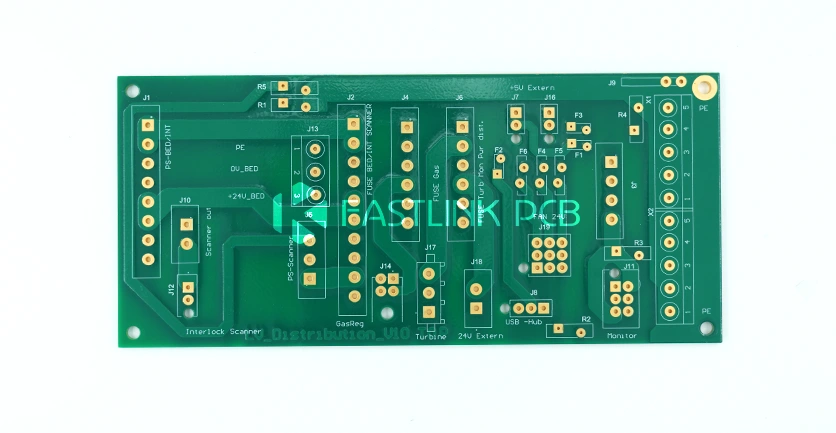
When evaluating an FR-4 PCB, thermal conductivity stands out as a major bottleneck. While the material works beautifully as an electrical insulator, it performs poorly as a thermal conductor.
The Thermal Limits of FR-4
- The Baseline Numbers: Engineering datasheets and thermal simulations typically rate FR-4 thermal conductivity between 0.25 and 0.35 W/m·K, usually defaulting to a flat 0.3 W/m·K. Because FR-4 is a composite of epoxy resin and woven fiberglass, heat tends to trap right around the component. The raw substrate simply cannot move heat away on its own.
- The G10 Comparison: Designers frequently stack FR-4 up against G10. Thermally speaking, they are identical—G10 also sits right at 0.3 W/m·K. The choice between them comes down to electrical specs and flame-retardant ratings, not thermal behavior.
FR-4 Versus Copper: The 1000x Gap
On a real board, the substrate isn’t meant to carry the thermal load. That job belongs entirely to the copper.
- Copper Thermal Conductivity: 390 to 400 W/m·K.
- The Design Reality: Copper moves heat over 1,000 times better than FR-4. Why waste time sourcing a slightly premium grade of FR-4 when you can just beef up the copper weight (oz) or expand your copper pours? Heavy copper is the true backbone of your thermal strategy.
Anisotropy
FR-4 is anisotropic, meaning heat travels through it differently depending on the direction.
- In-Plane (Horizontal): Because the internal fiberglass strands run parallel to the surface, heat moves sideways across the board with relative ease.
- Out-of-Plane (Vertical): Heat moving straight down through the PCB hits a wall of thick, low-conductivity resin layers.
For hot power components, heat cannot easily punch through the board to reach a backside heatsink. To bridge this gap, a design must use a vertical “thermal elevator”—such as a dense array of thermal vias or copper-filled holes—to force the heat through the PCB.
High Tg Does Not Mean High Thermal Conductivity
- High Tg FR-4 Is Not for Cooling: This is a frequent point of confusion. A high Glass Transition Temperature (Tg) rating simply means a board maintains its structural shape and resists warping when things get hot. Its raw thermal conductivity remains identical to a standard board. It will not move heat any faster.
- Specialty Thermal FR-4: You can find custom FR-4 formulations that bump thermal conductivity up to 0.6–1.0 W/m·K. Think about the trade-off, though: these laminates carry a high price tag and still fall far short of metal or ceramic options. They remain a niche solution.
How Engineers Work Around FR-4 Limitations
For standard digital logic boards and low-to-medium power control circuits, FR-4 handles the job beautifully. When a high-power component introduces thermal stress, an experienced designer rarely swaps out the substrate for an exotic material. Why? Because you can bypass the thermal limits of FR-4 with smart layout choices:
- Beefing up the copper weight: Move more heat by moving to a thicker copper foil.
- Pouring massive ground planes: Use solid, continuous copper pours to spread heat across the entire surface area.
- Dropping thermal via arrays: Drill a grid of stitched vias right under hot pads to act as a vertical heat pipe.
- Direct mechanical coupling: Mount the PCB directly to a metal chassis or a heavy heatsink to pull heat off the board.
Unless a design pushes extreme power densities that demand an aluminum-core or ceramic substrate, optimizing the layout geometry is always the most economical strategy. Squeezing every bit of thermal performance out of standard FR-4 remains the best choice for commercial production cost.
The Density of FR-4 PCB
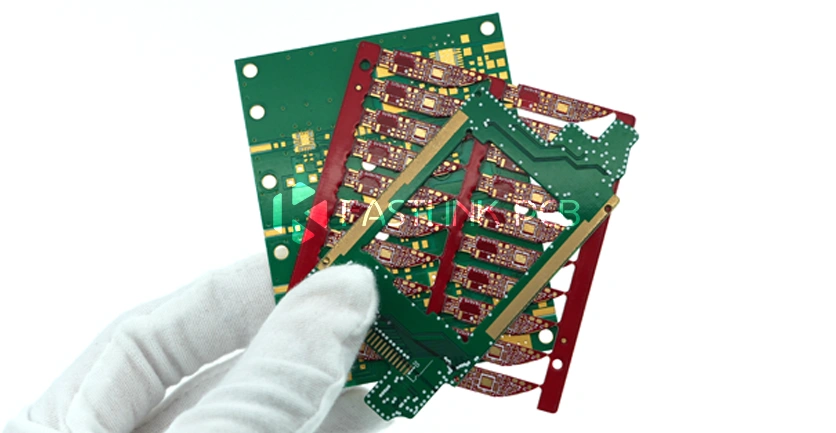
Standard FR-4 sheets typically show a density range between 1.70 and 1.90 g/cm³. Flip through most technical datasheets, however, and you will find that the industry defaults to an average baseline of roughly 1.85 g/cm³.
Compared to other insulating substrates, FR-4 sits on the heavier side. Standard paper-based laminates usually hover between 1.0 and 1.3 g/cm³, while older phenolic resin boards top out around 1.3 to 1.5 g/cm³. Why does this matter? Because this high structural density is the exact reason FR-4 delivers such excellent mechanical strength and dimensional stability on an assembly line.
| FR-4 Type | Density(g/cm³) | Typical Applications | Key Features |
| Standard FR-4 | 1.80-1.85 | PCBs, general insulating materials | Balanced properties, economical |
| High-density FR-4 | 1.85-1.90 | High-voltage applications, transformer components | Enhanced mechanical strength |
| Low-density FR-4 | 1.70-1.75 | Weight-sensitive applications | Reduced weight, excellent insulation |
| High Tg FR4 | 1.82-1.88 | High-temperature environments | Superior thermal stability |
Manufacturing Drivers Behind FR-4 Material Density
Minor shifts in final board density come down to precise process control during fabrication. Four core variables dictate the outcome:
- The Glass-to-Resin Ratio: Woven fiberglass is much denser than epoxy resin. Raise the fiberglass content within the resin matrix, and the overall weight and tensile strength of the laminate climb accordingly.
- The Weave Profile: The tightness of the fiberglass cloth weave determines exactly how much open space remains for the resin to fill.
- Resin Saturation: The manufacturer must ensure the prepreg is completely saturated with epoxy, leaving zero micro-voids or air pockets trapped inside.
- Lamination Pressure: The raw mechanical force applied during the high-temperature press cycle dictates the final compactness of the cured board.
Final Thought
Understanding the dielectric strength, Dk value, thermal conductivity, and density of FR-4 comes down to a single goal: finding the safety boundaries of a design. FR-4 is not flawless. It has clear thermal and high-frequency limitations. However, great hardware engineering rarely relies on choosing the most expensive material on the market. Instead, it relies on using smart layout choices and structural cooling to squeeze the absolute highest performance out of a classic substrate.
A great circuit design requires rigorous fabrication to come to life. As a manufacturing partner, FastlinkPCB brings deep expertise to the table. The team offers advanced capabilities for high-frequency multilayer boards alongside more than 17 years of experience producing standard FR-4 hardware.